
Colour is defined as
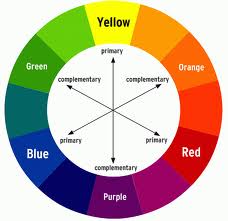 “The sensation experienced or caused by light reflected from or transmitted through objects”. In the strict sense, we cannot directly measure perceived colour, however we can measure and subsequently calculate certain factors which are responsible for producing this sensation of colour.
Luminance Contrast Testing is carried out to determine the sensation experienced or cause by reflected light of a surface. It’s important to note the the type of finish and surface itself influences this sensation.
Perception of color begins with specialized retinal cells containing pigments with different spectral sensitivities, known as cone cells. In humans, there are three types of cones sensitive to three different spectra, resulting in trichromatic color vision. The cones are conventionally labeled according to the ordering of the wavelengths of the peaks of their spectral sensitivities: short (S), medium (M), and long (L) cone types.
These three types do not correspond well to particular colors as we know them. Rather, the perception of color is achieved by a complex process that starts with the differential output of these cells in the retina and it will be finalized in the visual cortex and associative areas of the brain. For example, while the L cones have been referred to simply as red receptors, microspectrophotometry has shown that their peak sensitivity is in the greenish-yellow region of the spectrum.
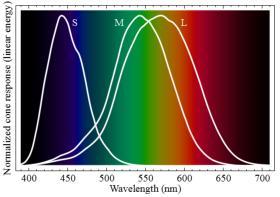 Similarly, the S- and M-cones do not directly correspond to blue and green, although they are often depicted as such. It is important to note that the RGB color model is merely a convenient means for representing color, and is not directly based on the types of cones in the human eye. The peak response of human cone cells varies, even among individuals with ‘normal’ color vision;
Nothing is capable of measuring colour / luminance contrast as well as what the natural eye is capable of doing. The Australian Standards that specify the equipment to use to test luminance contrast is AS1428.1 – 2009 & AS1428.4.1 – 2009. These standards state that the instrument to be used in a laboratory test is:
“A tristimulus colorimeter, or spectrophotometer with a diffuse illumination/normal viewing (d/o) geometry, is used with CIE Standard Illuminant D65. The instrument has to be capable of measuring absolute CIE for Yxy to be calculated. The measured luminous reflectance is defined by the tristimulus value Y. The chromaticity coordinates x and y provide an indication of the colour.” and for On-site “A single lens reflex luminance meter commonly known as a photometer with a 1° measurement field and a spectral responsivity approximating the CIE 1931 Standard Observer V (λ) function as specified in ISO 11664-1 are to be used.”
It is important to note the geometry required for tristimulus colorimeters and spectrophotometers – (d/0). What this means is that the light source is diffused through a spherical dome and the receptor (measuring point) is at 0degrees. This is best shown in the below picture.
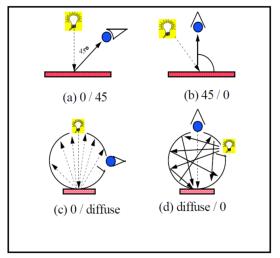 Whenever testing is conducted to establish contrast ratios for the purposes of compliance under AS1428.1 & AS1428.4.1 it is essential that the testing company has the correct geometric equipment. Should a case ever be brought into a court of law the scrutiny would be straight on the testing equipments compliance to the standards. If wrong equipment is used then wrong results will be given which increases the chances of possible litigation
What is not mentioned in these standards and is of great significance in terms of luminance contrast is Specular Inclusive and Exclusive measurements. Specular Inclusive measurements are “Colour” and Specular Exclusive measurements are “Appearance”. Meaning that in terms of luminance contrast of colours the best testing to determine contrast is Specular Inclusive. All of the Dulux LRV’s contained in the rear of the fan deck are Specular Inclusive measurements. If appearance measurements are required then the Photometer tests can be performed (Note that these are effected by ambient light). Luminos Consulting laboratory test are Specular Inclusive.

 contact us