
Equal Access undertakes the following services:
- Undertake luminance reflectance testing of a single product or surfaces. Ten readings will be taken in both dry (and wet if applicable) conditions in accordance with AS 1428.4.1:2009 and/or AS 1428.1:2021. Record the luminous reflectance (Y value) for each individual dry measurement that is taken. The luminous reflectance (Y value) of the CIE 1964 colour system is recognised in AS/NZS 1580.601.2.
LRV is a measurement that quantifies the total percentage of visible and usable light reflected by a surface across all wavelengths when illuminated by a light source. This testing can be undertaken both in-lab and in-situ.
- Prepare a Luminance Contrast report using the measured luminance reflectance values, and calculate the luminance contrast. The luminance contrast (C) of two surfaces has to be calculated using the following equation:
C = 125 (Y2 − Y1)/(Y1 + Y2 + 25) Bowman-Sapolinski equation*
where
C = luminance contrast
Y1 and Y2 = luminous reflectance values of the two surfaces
The Luninance Contrast Testing undertaking by Equal Access will comply with Australian Standards. These tests are conducted by using only compliant geometric equipment and we provide equipment detail reports as required in the Standards. It is important to note that there is NO Spectrophotometer that will meet the Standards Requirements.
Testing to Australian Standards AS 1428.1 & AS 1428.4.1
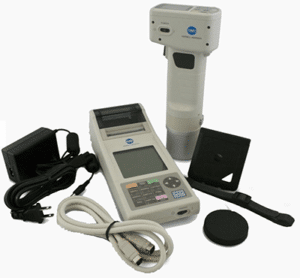
Australian Standards AS1428.1 & AS/NZS1428.4.1 require luminance contrast testing to be carried out with a specific measuring device. To quote the Standards –
AS 1428.1
B.3 Measurement of luminance contrast — Non-contact method
A tristimulus colorimeter, or spectrophotometer with a diffuse illumination/normal viewing (d/o) geometry, is used with CIE Standard Illuminant D65. The instrument should be measuring absolute CIE for Yxy to be calculated. The measured luminous reflectance is defined by the tristimulus value Y. The chromaticity coordinates x and y provide an indication of the colour.
B.5 Measurement of luminance contrast — Contact method
A single lens reflex luminance meter commonly known as a photometer with a 1° measurement field and a spectral responsivity approximating the CIE 1931 Standard Observer V (λ) function as specified in ISO/CIE 11664-1 should be used.
AS 1428.4.1
E3 Measurement of Luminous Reflectance
This Paragraph sets out a method for measuring the luminous reflectance of tactile indicators and other surface materials. The method is carried out with reference to a standard light source, which is an inherent feature of suitable colorimeters and spectrophotometers. This enables the test to be conducted both in the laboratory and on-site, and for published results to then be compared.
On-site Luminance Contrast Testing
As per AS 1428.1 & AS 1428.4.1
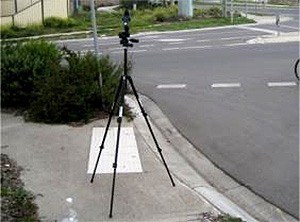 All of our on-site luminance contrast testing is performed using the equipment stated in AS1428.1 & AS/NZS1428.4.1, a single-reflex lens photometer. Testing conducted on TGSIs is always in compliance with the requirements set out in AS/NZS1428.4.1 and for all other building elements, as per AS1428.1.
Please note that at Equal Access, we are able to conduct tests at any location and we always supply our luminance contrast reports 2 business days after the test completion, unless priority delivery is requested.
Locations
Equal Access can undertake in-situ luminance contrast testing in all states and territories of Australia, having already undertaken testing in Victoria, New South Wales, Queensland, including FNQ, South Australia and Tasmania.
Both the laboratory and the onsite luminance contrast testing include both dry and wet luminance contrast ratios as applicable.