
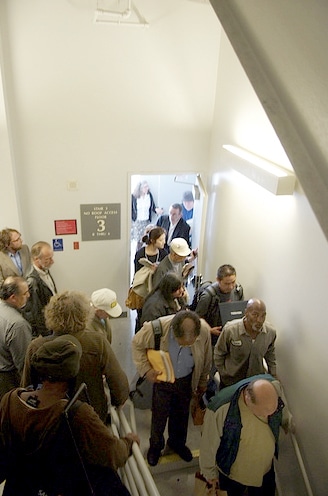
 Personal Emergency Evacuation Plans (PEEPs ) are customised documents that provide the framework for the planning and provision of emergency evacuation of people with a disability.
The most important component of emergency evacuation is – to get everyone out safely.
We know that with the increases in access to buildings the likelihood of having an individual with a disability in the building during an emergency evacuation is also increased.
Download our free
Personal Emergency Evacuation Plan PEEP Templates
 If people with a disability can get into a building then, given appropriate planning, they will be able to get out again in an emergency.
This is where Equal Access can assist. We take out the complexities and assist your organisation to holistically customise PEEP’s for ALL staff needs.
The people responsible for devising emergency evacuation procedures often lack sufficient information about disability conditions and issues. This is unsatisfactory, as our experience has shown that with well-informed staff, carefully designed facilities, appropriate planning and ongoing support, ALL staff will be catered for.
With Equal Access’s professional services your staff will be well-informed, prepared and confident, to develop emergency evacuation procedures for your organisation.
Government Authorities’ advice is:
“Generally speaking if a person is physically disabled the procedure is to leave them in a safe place on the floor with another employee staying with then. If they then need to be physically evacuated from the building, the person is removed from the workplace by the fireman attending the premises. WorkSafe has some physically disabled persons and this is the procedure we adopt.
If it was decided by the Fireman that a disabled person was required to be moved from a particular level they, as part of there training, would move the disabled person to a safe level below the level the fire is on. There would generally not be a need to completely move the person out of the building entirely.”
‘What’s a safe place?’ – This ad hoc policy is inadequate and is of great concern.

The Disability Standards for Accessible Public Transport 2002 otherwise known as the Transport Standa...
read more
Most people think an access consultant’s job is to identify where a design doesn’t comply; however, our role involves much more ...
read more
A recent update to The Disability (Access to Premises – Buildings) Standards 2010 (DAPS) came into effect on November 23, 2024. Among the changes was the inclusion of a reference t...
read moreKeep up with Disability Access Legislation using our free e-newsletter. Save yourself the headache of complaints and expensive last-minute upgrades. Sign up here!

 contact us