
Access Commentary
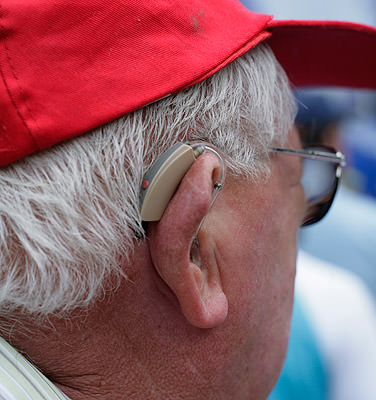 Clause D3.7 of the Premises Standards and the BCA outlines the current mandatory requirements for hearing augmentation systems within buildings to assist people with a hearing impairment.
This clause requires a hearing augmentation system to be provided in a number of building use scenarios where an inbuilt amplification system, other than one used only for emergency warning, is installed. It also specifies several acceptable systems, such as an induction loop system or a receiver-type system, and the extent of coverage.
The main building use that is required to have a hearing augmentation system under the premises Standards and the BCA is a public assembly (Class 9b) building.
The Class 9b classification under the BCA and the Premises Standards includes a variety of assembly buildings, such as a civic and community centre, church, library, public hall, school, pre-school, early childhood centre, nightclub, cinema, theatre, sports stadium, public transport terminal and the like. Although these public buildings share the same BCA/Premises Standards classification, the envisaged occupants and their use vary considerably. Consequently, the considerations for an effective hearing augmentation will vary between such buildings.
Clause D3.7(a) of the BCA (as well as clause D3.7(1) of the Premises Standards) requires a hearing augmentation system in any room of a Class 9b building that has an inbuilt amplification system, other than one only used for emergency warning. The Premises Standards and the BCA do not define an ‘inbuilt amplification system’, so what constitutes such a system remains subjective in some cases.
In the case of a public address (PA) system that is principally used for announcements, we believe that such a system is considered to be an ‘inbuilt amplification system’, so if PA speakers are provided in any room within Class 9b buildings, technically each of those rooms will require a hearing augmentation system. Conversely, if there are no PA speakers in a room, then a hearing augmentation system is not required by the BCA or Premises Standards.
There is no doubt that a hearing augmentation system integrated into a PA system in many types of public buildings is critical for people who have a hearing impairment. In most of these cases, the PA system is supplemented by visual cues or the display of information to ensure that people who have a hearing impairment know when to connect into the hearing augmentation system to hear announcements/messages by turning on the T-switch on their hearing aid or the use of headphones, stetoclips, earbuds, earpieces, inductive neck loops and the like.
But in public buildings with a PA system that do not have visual cues or displays, people who have a hearing impairment will most likely have difficulties in knowing when to link into the hearing augmentation system.
School buildings
With the case of a typical school building, there will not always be a visual cue to give people who are hearing impaired notification of the impending message from a PA system. If a hearing augmentation was to be integrated with a PA system, it would most likely be ineffective for people who have a hearing impairment, especially in corridors, offices, toilets and the like. It would only be effective if school buildings were supplemented with some form of visual cues, which is beyond the current prescriptive requirements of the BCA and the Premises Standards.
Consequently, the application of the ‘deemed-to-satisfy’ provisions of the Premises Standards and the BCA in school buildings can represent a very onerous requirement that will have little benefit to people with hearing impairments.
In such a scenario, we believe that a hearing augmentation system should not be provided in all of these rooms, but would encourage a focus on specific areas that will have a direct benefit to occupants with a hearing impairment, such installing a hearing augmentation system within meeting rooms, auditoriums, classrooms and the like.
Therefore, we feel that devising an ‘alternative solution’ that meets ‘performance requirement’ DP9 under the Premises Standards and the BCA is far more beneficial rather than applying the ‘deemed-to-satisfy’ provisions under clause D3.7. This allows a more tailored approach to apply hearing augmentation systems to key areas.
It is worth noting that careful consideration is required when devising a hearing augmentation system, as there are a number of factors that need to be considered. Although the BCA and Premises Standards include a number prescriptive parameters for the installation of a hearing augmentation system, it unfortunately does not consider a number of critical factors, such as sound reverberation and the acoustic quality of finishes, background noise, sound source distances, sound spillage, volume and shape of rooms, visual cues and if there is a direct line of sight between the sender and receiver of messages.
We suggest that hearing augmentation designs are developed in the early design phases of a project in conjunction with hearing augmentation specialists and acoustic consultants to help development an appropriate design to all key areas with the design team.
It is also worth noting that applying the ‘deemed-to-satisfy’ provisions under the BCA and the Premises Standards does not always provide a satisfactory outcome. The prescribed systems under the BCA or Premises Standards only cater for people with moderate to severe hearing loss. They do not cater for people with profound hearing loss or people who are deaf. Also, in some cases, a ‘deemed-to-satisfy’ solution may not always provide an effective solution. For example, installing a hearing loop system within a large public hall with poor acoustics may not be effective.
Conclusion
The design of effective hearing augmentation systems within buildings requires careful consideration with appropriate experts. In many cases, a tailored design using the ‘performance requirements’ of the Premises Standards and the BCA is considered to be far more beneficial than adopting a ‘deemed-to-satisfy’ solution. In some cases, a ‘deemed-to-satisfy’ solution is very onerous in Class 9b buildings with little benefit for people who have a hearing impairment or completely ineffective if the specific building parameters are not taken into account with the design.